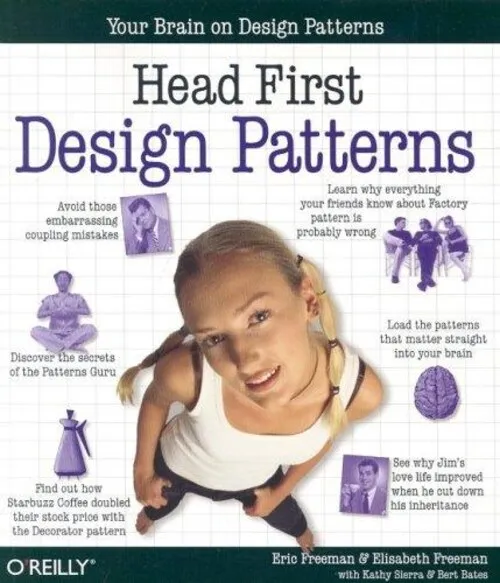
Head First Design Patterns (2004; 2nd ed. 2020) by Eric Freeman & Elisabeth Robson solved a real problem: the Gang of Four’s original Design Patterns was canonical and nearly unreadable for beginners (or experts for that matter). This takes the same catalog - Strategy, Observer, Decorator, Factory, Singleton and the rest - and teaches it in the deliberately goofy Head First style. It sounds gimmicky, but it works. Crucially, it leads with principles before patterns (favor composition over inheritance, program to an interface, encapsulate what varies), so by the time it names a pattern you’ve already felt the pain it solves - the only way patterns ever stick.
The caveats are scope and era: it’s pattern-evangelistic, so beginners risk reaching for a pattern where a plain function would do, and it’s Java-centric - several GoF patterns matter less in languages with first-class functions, where a Strategy is just a lambda. Read it to understand the patterns; learn restraint from experience. These days I’d pair it with two excellent online references - Refactoring.Guru and SourceMaking - which cover the same catalog with cleaner, multi-language examples you can skim.
Who is this book for?
Just about any developer. Newcomers meet the patterns without bouncing off the Gang of Four; experienced engineers get a fast refresher, a shared vocabulary, and a principles-first reframe worth rereading no matter how long you’ve been writing code. The format divides people, so flip through a chapter first.
I went back through it recently and wrote this short review mainly so I’d have a link to hand to anyone starting out who asks what to read.
The authors
Eric Freeman & Elisabeth Robson - longtime collaborators behind several titles in the Head First series and the WickedlySmart training company. Their real specialty isn’t patterns; it’s teaching, and this book is the proof.
the Gang of Four’s original Design Patterns was canonical and nearly unreadable for beginners (or experts for that matter)
And let me walk back that sharp line about the Gang of Four. It’s easy to call their book unreadable today - we have their vocabulary, their catalog, and decades of hindsight to stand on. But being there, with the tools and languages of the early ’90s, seeing far enough ahead to name these patterns and hand the whole industry a shared language - that took something rare.
Easy to critique from here; hard to invent from there.
Respect.